

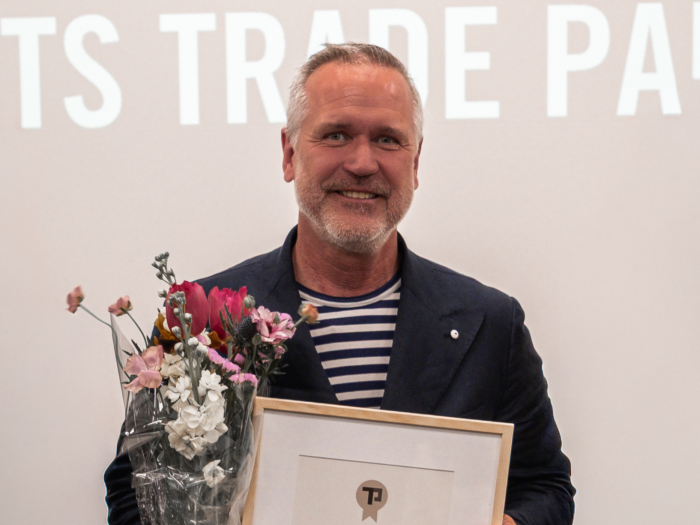
With more than three decades in the Swedish fashion industry, countless brands built from scratch and an unshakeable belief in the product over the trend, Flodell is one of the agents who has shaped how fashion is bought and sold in Sweden. Now Flodell Agenturer has been named Trade Partner of the Year. We sat down with the man behind the agency for a conversation about his background, his craft, and what really keeps a solo entrepreneur believing in his relationships.
The story begins far from Swedish buying days. Flodell was born in Argentina in 1967, one of triplets, with parents who worked abroad for ten years. He arrived in Vasastan, Stockholm, as a seven-year-old – a child who understood Swedish but spoke Castellano. His father was a priest, and the home was shaped by a Christian and sacred foundation along with great generosity, where everything was shared with everyone. Carving out his own identity and integrity in that setting mattered to him early on.
His interest in fashion was sparked in 1978. At twelve, he bought his first unwashed Levi’s 501 at Tempo – deliberately a size too big, so they would last. And they did: ten years, patched and mended, and worn with pride. That feeling for an iconic product has stayed with him ever since.
After studying economics, he chose to spend a year in Paris before military service. Between 1987 and 1989 he ran a company selling American tees, and there he discovered his talent for building relationships and selling. His first women’s collection came in 1989, and in 1993 he founded his own firm – just as he had made contact with Filippa Knutsson, whose father owned Gul&Blå. Flodell had been pestering the father about selling Fonzie and Marilyn; the answer was a recommendation to get in touch with Filippa, who had just created her first collection. That was where the agency began.
“The days I step out the door and meet people who dress with their own personal style – and the joy when I see someone wearing something I sold in to the stores. On those days we’ve succeeded, in all our collaborations, in conveying something amid all the competition. You who run stores and buy in, and we who source brands and develop styles we believe in before anyone else is even convinced. That’s what drives us forward.”
For Flodell, the stance is clear: “Fashion is anxious, a trend is a tendency. But the product is everything. The brand means nothing as long as you don’t cherish and care for the product the right way.”
He is equally clear about what doesn’t work. “Greed in this industry is a failure. When decisions are justified with ‘it’s business, not personal,’ and you lose your ethical compass – then you won’t last. I’ve seen so many brands come and go since the 1980s.”
Another source of pride is the talent nursery he has built since hiring his first employee. “When I hear that the years we worked together were extremely valuable and shaped them into who they are today – that makes me happy to have been a mentor to so many.”
He chooses his customers with care. “I don’t want to sell to everyone. I want customers who love what they’ve bought and trust that I’ve done the job for them. I often say I’m happier in my little neighbourhood bar of fashion than I was running a company with eleven employees and eighteen brands.”
Being an agent has a downside too, and Flodell is open about it. Collaborations have ended on poor ethical grounds, and brands have wanted to take over without doing right by him. “In other industries, you succeed and you get a bonus – in ours, you succeed and you get fired, and no one wants to pay. Being a solo entrepreneur isn’t easy. But the superpower is positivity: to keep believing in your relationships and not give up. When customers come back and say, ‘Flodell, we’ve sold everything we bought from you’ – that scent is magical. That’s why you keep going.”
“I’ve been a member for a long time and have been helped many times – with drawing up contracts, with support in discussions, and with brokering contacts with brands. The new trade-fair format is starting to bear fruit; more of us want to develop it and make the customers understand that it’s worth the trip out to Nacka. We want it to become more and more about real buying days, where you make a lot of purchases efficiently all at once. There are so many seasons today, and both buying and selling are demanding. Time is precious – which is why I think more people need to be part of developing this together.”
And his message to the buyers is simple: “Please, come and buy. Take advantage of the privilege that so many of us talented people gather in one place. It can only lead to exciting new relationships – and maybe a cool new label you’d never have come across otherwise.”
He remembers the Älvsjö fair in the 1990s, full of brands and buyers. “Stockholm lost its place as the fashion capital of the Nordics when the fair was shut down in 1997. It’s been faltering ever since. That’s something we have to change.”
“A really welcome contribution to that big hole called finances. It’s not easy running your own business, and costs are spiralling on every front.” The scholarship will go towards his own professional development in a new subject. “Maybe AI, maybe a new language?”
Flodell sums it up in four “dangerous F’s”:
“Honestly, what we do is incredibly complicated. So many things have to line up, from planning to delivery.”
His concrete advice is about curiosity and presence. “Ask questions. Be curious, visit your stores often, keep your ear to the ground. What’s happening today? Why didn’t this sell? Or – how great, why did that one sell so well? What brand mix do you have, what’s missing?”
A lot of it also comes down to finding the right partner. “Writing a contract at the start isn’t always necessary – you’re fundamentally well protected by EU legislation, so lean on that. Think long-term, don’t oversell, protect the finances – including towards your customers. Make sure your suppliers have good systems and that deliveries arrive on time. Believe in yourself, trust your instinct – and love what you do.”
“With my background of having found so many brands that I’ve helped build from zero on the Swedish market – the privilege of writing that first order, the virginity of the label – is the most fun you can have. Every single time.”
He closes with a message that touches the whole industry: “We have to be driven by selling more quality than quantity. Get people to question cheap production and to shop with their local hero rather than some unknown e-tailer. The ones standing there seven days a week know what you need. Buy less, but good things – and ask where it was made.”
“We have an industry that gives a lot of people work. Our calling is to bring people joy. Our experience industry must not lose what matters most: design with its own DNA, products in the right channels, stores run by entrepreneurs who want to run multibrand with their own feel towards the end customer. Individuality at every level.”
Thank you. Gracias. Salve. – Flodell